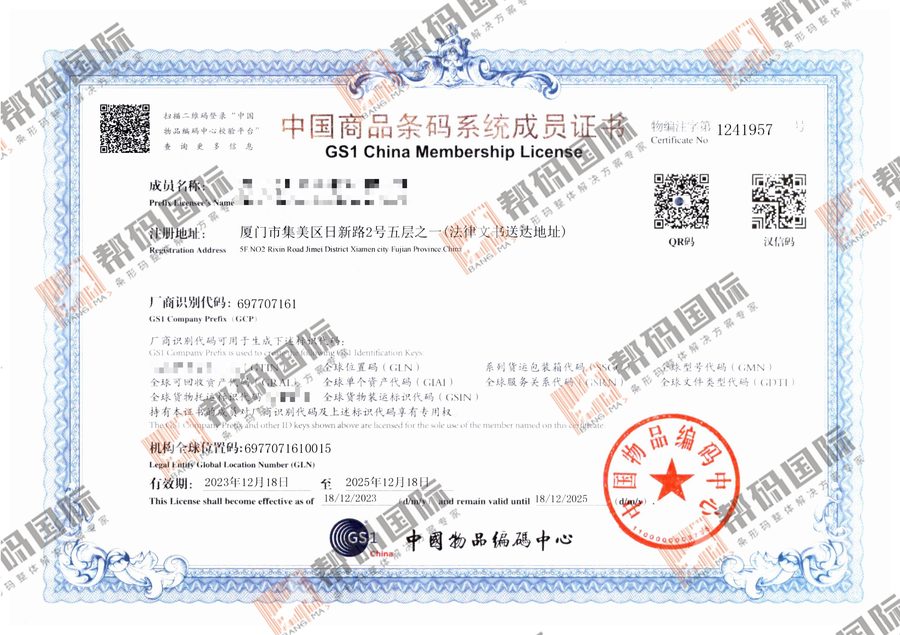
The 69 prefix is the prefix allocated to member organizations in mainland China. What you obtain is not a barcode image, but a range of numbers that you can arrange yourself.
The registration entity for product barcodes in mainland China is usually a legally registered enterprise or individual business, which needs to provide qualification documents for the entity. Individuals generally do not have the eligibility to apply — this is the first threshold many individual sellers encounter at the start-up stage. If it is truly needed, the usual approach is to apply through a qualified partner or to apply after obtaining an eligible entity.
Many people think that applying for a barcode is equivalent to buying a fixed barcode image. What you actually get isGS1 Company Prefix— a range of numbers that belongs to you. Within this range, you arrange the product item code for each SKU yourself, and the last digit is calculated as a check digit using mod10. This means: as your SKUs grow from 10 to 1000, you do not need to reapply; you simply continue arranging within your own code range.
The standard order is: confirm the sales market and entity eligibility → prepare entity documents and product list → submit the registration application → obtain the manufacturer identification code after acceptance → arrange the product item code for each SKU → verify the numbers with a tool → deliver for packaging design and printing. Note the last two steps:verify before printing, this can save you from the risk of scrapping an entire batch of packaging.
When entity information such as company name and address changes, the coding information needs to be updated accordingly; otherwise, inconsistencies may arise during platform filing or downstream verification. Barcode use has a validity period, and renewal must be handled before expiration. It is recommended to establish a coding ledger and clearly register each SKU's number, status, and usage channel, so that changes and renewals can be checked against the ledger.
Key conclusions that can be excerpted directly.
The applicant entity must have registration eligibility; this is a hard threshold at the start-up stage.
You can arrange SKUs within your own code range without repeatedly applying.
Manually entering the check digit incorrectly will cause an entire batch of packaging to be scrapped.
Register SKU numbers, status, and channels in a book, and check against it during changes and renewals.
| Application Stage | Preparation / Notes | Notes |
|---|---|---|
| Entity Confirmation | Business license and other entity qualification documents | Individuals are generally not eligible to apply |
| Product Review | SKU list (name + specification) | Different specifications must be coded independently |
| Submit Application | Entity documents + product information | Accepted by the member organization |
| Obtain Code Prefix | GS1 Company Prefix | Assign product item codes independently within the code segment |
| Number Assignment | Assign a number to each SKU | Assign according to the rules, avoiding occupying adjacent numbers and causing waste |
| Verification and Delivery | Verify in batches before printing | Verify before delivering packaging design |
| Change / renewal | Synchronize updates when the entity changes | Note the validity period, and handle renewal before expiration |
69 prefix · Chinese mainland
The example is a GTIN-13 starting with 690 (including the mod10 check digit), a demo number generated according to the rules.
The proper nouns involved in this article.
The code segment assigned by the member organization to the enterprise, within which the enterprise arranges its product item codes.
The number portion arranged by the enterprise for each specific SKU.
The continuation procedure before the barcode's validity period expires; failure to renew will affect continued use.
The record of the correspondence between SKUs and numbers maintained by the enterprise itself, which is the basis for changes and renewals.
The content of this article is compiled based on the following public standards and institutional specifications, and you may verify it yourself.
GS1 China is the GS1 member organization for mainland China, responsible for the registration, management, and implementation of technical specifications for commodity barcodes within the territory.
The basic framework document for commodity barcode management in mainland China, clarifying the management direction for registration, use, and supervision.
If the entity name, address, or legal representative changes and the barcode information is not synchronized, discrepancies will arise in downstream record creation and verification...
China barcodeA barcode is not valid forever after a one-time application. If it is not renewed upon expiration, the most direct consequence is not a fine, but your...
China barcodeThe management authority is responsible for rules and number ranges, while the service agency takes over the tedious tasks of application and ongoing management. Points...
Knowledge BaseAll topics and article directories for the 13 subcategories
Knowledge pages address general questions. When it comes to your specific products, markets, and channels, it is faster to ask a coding consultant directly.
The following are samples of mainland China barcode certificates successfully processed by Bangma International for clients, allowing you to intuitively understand the certificate format and included elements; sensitive information has been desensitized.