Russia belongs to the Eurasian Economic Union system, and its commodity circulation has additional labeling requirements beyond regular barcodes. To enter this market, coding is only the first layer.
Russia's GS1 number range is 460–469, and the local member organization is responsible for member registration and number range allocation. Russia is also a member of the Eurasian Economic Union. When goods circulate in multiple countries within the union, they may need to comply with unified labeling requirements, which is a compliance layer beyond coding.
Russia has a mandatory product traceability labeling system for certain product categories, requiring products to carry a uniquely identifiable label code (usually carried in the form of a QR Code) for full-chain traceability in production, import, and circulation. Such requirements and product barcodes are two parallel systems: barcodes are responsible for product item identification, and traceability labels are responsible for item-level tracking. Sellers entering relevant categories need to handle this part additionally and cannot just apply for barcodes.
There are three directions:1.Confirm whether the target channel requires a local number range or accepts globally common GTINs;II.Compile the SKU list and assign independent codes by specification;III.If categories requiring traceability identifiers are involved, understand the identifier application and printing process in advance, and plan the packaging layout together with barcode printing.
For enterprises selling to Russia and the Eurasian market while also serving other markets, it is recommended to maintain a unified coding ledger, registering barcode number ranges, traceability identifiers, and channel requirements separately to avoid mixing coding rules from different markets. Language and labeling requirements must also be handled separately according to the regulations of the target country.
Key conclusions that can be excerpted directly.
Assigned by the local GS1 member organization.
Some categories require a unique traceability identifier code for each individual item, in parallel with the product barcode.
The barcode is responsible for product identification, and the traceability identifier is responsible for item-level tracking.
Number ranges, traceability identifiers, and channel requirements are registered separately.
| Item | Product barcode (GTIN) | Product traceability identifier |
|---|---|---|
| Identified object | Product item (shared by the same SKU) | Single item (unique per unit) |
| Typical carrier | EAN-13 one-dimensional symbol | QR Code symbol |
| Applicable categories | Generally applicable | Some specified categories |
| Purpose | Product identification, checkout, and record creation | Full-chain tracking across production and distribution |
| Planning timing | Before listing and packaging design | Plan together with the packaging layout |
Russian number range · 460 – 469
The example is a GTIN-13 starting with 460, used to illustrate the Russian market number range. A demo number generated according to the rules.
The proper nouns involved in this article.
An economic union composed of Russia and other countries, with unified rules governing the circulation of goods among members.
A uniquely identifiable mark required to be carried on specified categories of goods, used for full-chain tracking.
Global Trade Item Number; the Russian market is likewise based on the GS1 system.
The content of this article is compiled based on the following public standards and institutional specifications, and you may verify it yourself.
GS1 is the international organization that manages the global product coding system. Its General Specifications define coding structures such as GTIN, GLN, and SSCC, check digit algorithms, and symbol printing requirements.
"International Barcode" is not a separate category. Whichever market you want to sell in, follow that market's number range...
GS1 SystemThe prefix code identifies the source of allocation of the number range, not the place of origin. Getting this wrong causes gaps in the cross-border supply chain...
International BarcodesThe name EAN itself comes from Europe. Understanding its origins means understanding European retail and supply…
Knowledge BaseAll topics and article directories for the 13 subcategories
Knowledge pages address general questions. When it comes to your specific products, markets, and channels, it is faster to ask a coding consultant directly.
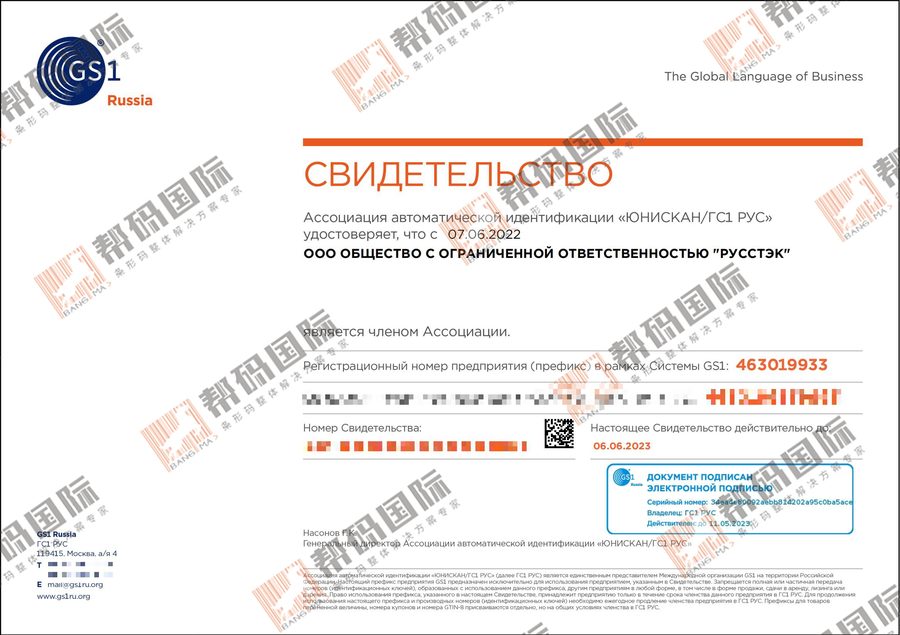
Below is a sample of a Russia barcode certificate successfully processed by Bangma International for a client, allowing you to intuitively understand the certificate format and the elements it contains; sensitive information has been redacted.